Early Contractor Involvement (ECI) in Precast
Early Contractor Involvement (ECI) is becoming a strategic advantage in precast concrete projects, where precision, timing, and planning are key to success.
2 min read
Sustainability, technological integration and performance are converging to redefine project outcomes, and precast concrete is leading that transformation.
Precast concrete is where most of that convergence is happening, and five developments in particular are worth the attention of anybody specifying it.
The global precast concrete market is projected to grow from $150.2 billion in 2025 to $247.5 billion by 2035, on a 5.7% compound annual growth rate. That reflects the sector's shift toward modular methods, which reduce programmes by 36% compared to traditional approaches. Walls, floors and structural beams dominate demand, because of their versatility across residential, commercial and industrial projects.
Precast concrete's inherent sustainability is amplified by circular economy principles. The EU funded ReCreate project, which ran pilots in Finland, Sweden, Germany and the Netherlands to 2025, aims to reuse precast elements from demolished buildings, targeting a 50 to 70% reduction in embodied emissions. By refurbishing elements in controlled factory conditions, the approach minimises raw material extraction and waste.
An integrated digital twin framework enables live monitoring and adaptive control of precast production. By simulating production plans using genetic algorithms, the system minimises waste and synchronises factory output with on site assembly. We use similar digital twin models to optimise logistics, ensuring just in time delivery of components and reducing idle time by up to 20%.
Robotic automation is changing prefabrication, with 3D printing robotic arms producing complex architectural features and entire building sections. These systems achieve millimetre precision, reducing rework and labour cost. In one case, 3D printed concrete panels for a Dublin residential project cut installation time by 40% while improving thermal performance.
Precast concrete's acoustic properties deliver noise reduction ratings of 47 to 48 dB(A) in field conditions, exceeding building code requirements. That matters for urban development near high traffic zones, where internal noise levels can be reduced by 30 dB(A).
Fire resistance is the other hallmark. Precast structures compartmentalise flames passively, containing a fire without external intervention. The Forest House apartments in New York used insulated precast walls with fly ash additives, achieving three hour fire ratings and reducing potential spread by 60%. Designs like that lower insurance premiums and improve occupant safety, with lifecycle cost savings that outperform timber frame alternatives.
Our expertise spans the entire project lifecycle, supported by interactive 3D models that generate structural calculations, drawings and quantity take-offs as the design moves. On one Cork hotel, that approach resolved complex load bearing challenges using precast twin walls and shortened the construction schedule by six months.
We prioritise collaboration, aligning architectural intent with engineering rigour. By integrating sustainability metrics and digital tools early in the design phase, we make sure a project meets both its performance benchmarks and its net zero targets.
Early Contractor Involvement (ECI) is becoming a strategic advantage in precast concrete projects, where precision, timing, and planning are key to success.
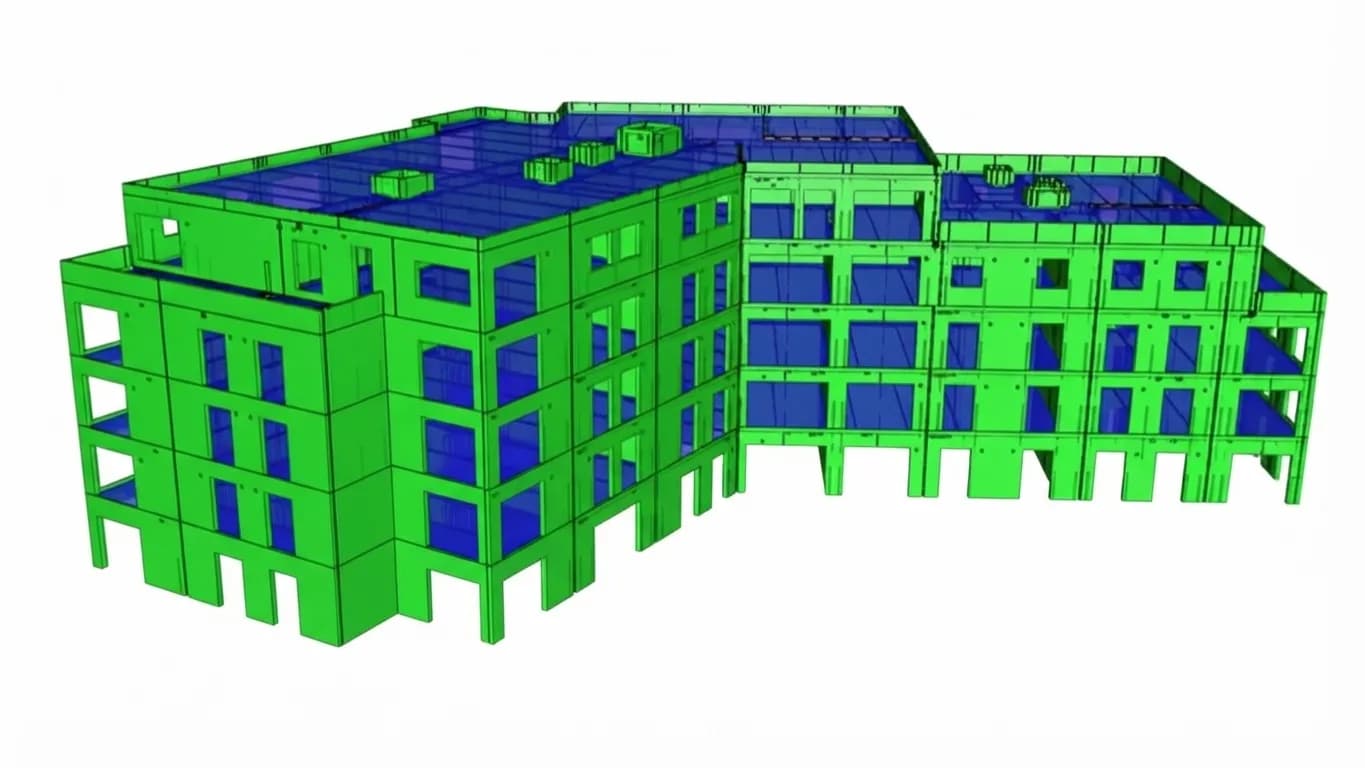
BIM is one model everybody works from instead of a set of drawings everybody redraws. On a precast job that changes who finds the clash, and when.
Drawings, a specification, or the site address and the programme dates: whatever you have is enough to start. We come back inside two working days, and a written fee proposal against a defined scope follows within three working days of that.