The modern construction industry operates under immense pressure. Across the globe, there is a relentless demand to deliver complex projects faster, more cost-effectively, and with a greater commitment to sustainability than ever before.
Contents
This challenge is acutely felt in nations like Ireland, where, as the Irish Concrete Federation has warned, ambitious housing targets are at risk due to material shortages and strained supply chains.
In this high stakes environment, fundamental choices in methodology can determine a project's success or failure. For decades, a critical decision point for developers, architects and contractors has been the choice between precast concrete and traditional cast in situ concrete.
This article moves beyond anecdotal evidence to a data driven comparison of the two, across cost, timeline, safety and sustainability.
Off site manufacturing against on site pouring
Understanding the fundamental differences between precast and in situ concrete is a strategic imperative. This initial choice dictates project planning, logistics and outcomes from day one, shaping everything from labour allocation to risk management.
Precast elements are cast in a factory, cured under controlled conditions and delivered to site as finished components. In situ concrete is poured, formed and cured in place, in whatever weather the site has that week. Everything below follows from that one difference.
Cost and efficiency, head to head
Project viability is tied to financial performance. While initial material prices are a consideration, a true economic analysis must evaluate the total project cost, including labour, waste and long term expense.
Total project cost
A comprehensive five year data analysis indicates that precast concrete can generate savings of up to 70.4% in total project costs compared to cast in situ. This reduction stems from efficiencies gained across multiple project phases, including labour, material management and project scheduling.
Labour efficiency
Factory based production allows precast construction to operate with 26% less manpower. The manufacturing process is streamlined, and the need for on site labour for building, erecting and stripping formwork is eliminated. In situ concrete, by contrast, requires more skilled labour on site for the critical tasks of pouring, setting and curing, often leading to higher wage bills and extended project durations.
Material wastage
Material waste represents a significant and often hidden cost. The controlled manufacturing environment of precast concrete is exceptionally efficient, with a default material waste rate of only 1%, as excess materials can be immediately reused. In situ concrete, by contrast, has a default waste rate of 5%, because of the inherent variability of on site mixing, the potential for spills and errors in formwork.
Lifecycle costs
The benefits of precast extend beyond the construction phase. Components cured in a controlled factory environment exhibit higher durability, resulting from controlled curing, which leads to fewer defects and lower long term maintenance and repair costs.
Insurance premiums
Concrete buildings are classified in the most favourable fire insurance category. A French study shows that selecting a concrete frame and walls can lead to a potential 20% reduction in insurance premiums, reflecting the material's favourable risk profile.
Measure
Precast
In situ
Total project cost
Up to 70.4% lower
The baseline
Labour
26% less manpower
The baseline
Material wastage
1%
5%
Lifecycle cost
Higher durability, fewer repairs
The baseline
Insurance premiums
Up to 20% lower on a concrete frame
The baseline
The cost advantages of precast construction are directly linked to its impact on project scheduling and timelines.
The race against the clock
In construction, time is one of the most critical resources. Accelerated project delivery translates directly to a quicker return on investment, reduced overheads, and the ability to meet urgent societal demands, such as resolving the Irish housing crisis. Precast concrete offers a decisive advantage here.
Overall time reduction
Data consistently shows that precast concrete reduces the overall construction timeline by 40 to 50%. This acceleration allows for faster project turnover and earlier revenue generation.
Elimination of curing time
Precast components arrive on site fully cured and ready for immediate installation. This bypasses the lengthy on site curing and drying times associated with in situ concrete, which can halt progress for days or weeks at a time.
Reduced weather dependency
The fabrication of precast elements occurs indoors, in a controlled factory environment, making the production schedule immune to weather related delays. In situ concrete, poured on site, remains highly vulnerable to rain, frost and extreme temperatures, which can push deadlines and inflate costs.
Logistical efficiency
Precast manufacturing facilitates just in time delivery, where components arrive precisely when they are needed for installation. This reduces site congestion, minimises scheduling conflicts and improves overall logistical efficiency.
Measure
Precast
In situ
Overall programme
40 to 50% shorter
The baseline
Curing
Done in the factory, delivered ready to install
Needed on site before the next trade can follow
Weather
Cast indoors, on schedule
Exposed, and paused when the weather says so
Logistics
Just in time delivery
Materials stored and worked on site
A real world case study illustrates the advantage: a high rise project using precast technology was completed six months ahead of schedule, saving the developers millions in operational costs compared to a similar cast in situ project.
Fire safety and durability, compared
Beyond cost and speed, a building's primary function is to provide a safe, resilient and durable environment for its occupants. This section evaluates the performance of concrete structures in the most extreme conditions, using evidence from real disasters.
First, it is worth establishing the baseline fire performance inherent to all forms of concrete, whether precast or in situ. Concrete is an exceptional fire resistant material for three reasons:
Non-combustible: concrete cannot burn and therefore does not contribute to a building's fire load.
An effective fire shield: concrete has a low rate of temperature transfer, protecting internal zones, shielding escape routes and preserving the integrity of structural elements.
No toxic emissions: unlike many other building materials, concrete does not produce smoke, toxic gases or molten particles when exposed to high heat, which are primary causes of fire related fatalities.
While these properties are common to all concrete, real disasters show that structural performance is what decides the outcome. Two cases demonstrate how well engineered concrete systems, designed for compartmentalisation and structural robustness, prevent catastrophic collapse under extreme conditions.
The Windsor Tower, Madrid, 2005: when a severe fire engulfed this 29 storey high rise, its concrete structure proved critical in preventing a total catastrophe. The building's central concrete core and columns, along with two deep technical floors made of massive concrete transfer beams, successfully contained the blaze for over seven hours. That compartmentalisation prevented progressive collapse, maintained structural stability and saved the surrounding area from far greater destruction.
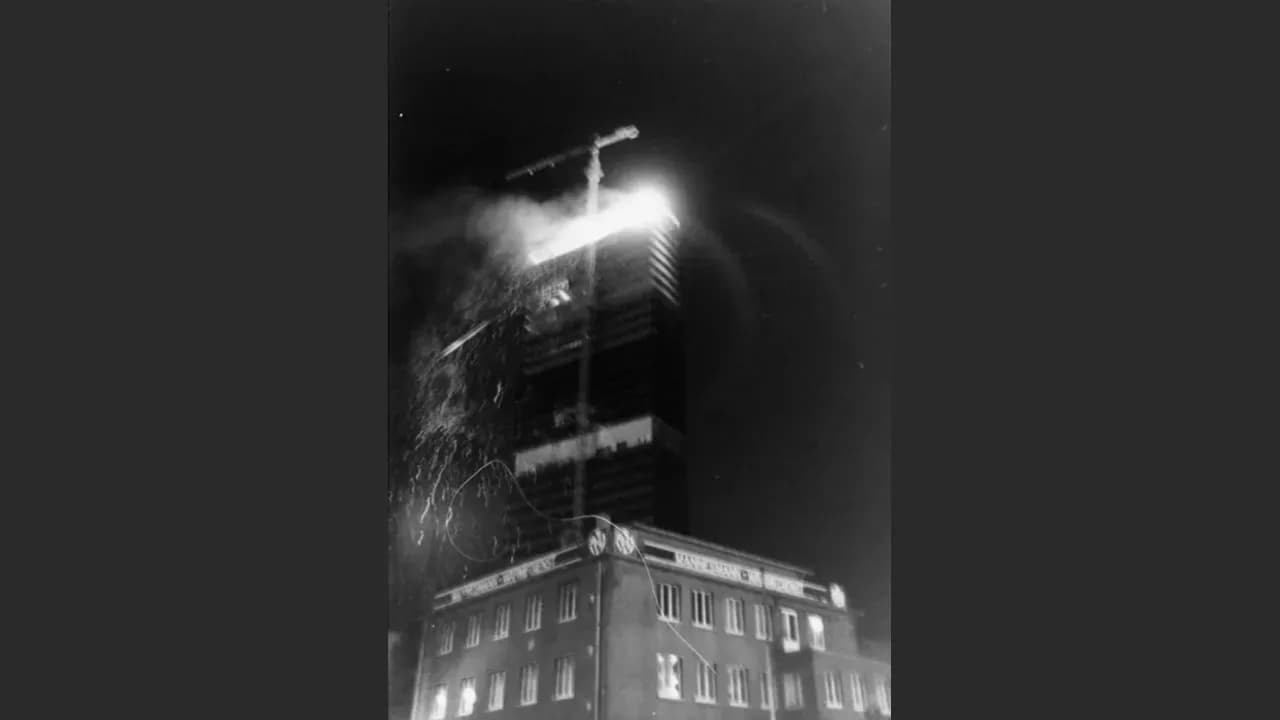
Frankfurt high rise fire, 1973: a fire raged for hours on the upper floors of a 140 metre office building. The reinforced concrete structure withstood the intense heat for approximately four hours. Despite significant surface spalling, the structure did not fail. In the aftermath it was deemed repairable, and the damaged elements were restored using guniting, or sprayed concrete, which demonstrates the material's robustness and its capacity for repair even after extreme events.
The Frankfurt high rise fire of 1973. The concrete frame stood through about four hours of it and the building was afterwards judged repairable. Photograph from Jonas Schwering, Impact of the Grenfell fire on Frankfurt Fire Service.
The primary differentiator for precast concrete lies not in the material itself but in the manufacturing process. Factory controlled casting, curing and quality assurance eliminate on site variables, such as weather, formwork integrity and curing conditions, that can introduce unseen weaknesses into in situ structures.
This gives precast a higher degree of engineered reliability, so the designed fire compartments and structural elements perform exactly as specified.
A whole life carbon perspective
Sustainability is no longer an optional extra in construction; it is a regulatory and ethical requirement. Mandates such as the EU's Energy Performance of Buildings Directive and national targets like Ireland's Climate Action Plan compel the industry to measure and reduce its environmental impact. To compare precast and in situ methods accurately, we have to analyse them through the lens of whole life carbon, which assesses emissions across a building's entire existence. There is more on how that calculation is being made law in Ireland in our piece on carbon accounting.
Production and construction, modules A1 to A5
In the initial stages of raw material supply, manufacturing and construction, precast concrete demonstrates a clear advantage. The optimised factory production process uses energy and resources more efficiently. Material waste is drastically reduced, 1% for precast against 5% for in situ, which directly lowers the embodied carbon of the final structure. The reduced on site activity associated with precast also minimises energy use from machinery and lessens local disruption.
Use stage, modules B1 to B7
Over a building's operational life, precast's higher durability, a result of controlled factory curing, can lead to fewer repairs and replacements. All concrete structures also benefit from a natural process called carbonation, where they gradually absorb CO₂ from the atmosphere. One study noted that this process can sequester an estimated 3% of total concrete emissions over a 50 year period, effectively turning the building into a passive carbon sink.
End of life, modules C1 to C4
At the end of a building's useful life, both concrete types perform exceptionally well in terms of circularity. However, the default end of life routes show a subtle but important distinction. While both have very high recycling rates, precast components have a designated potential for direct reuse, offering a higher value circularity pathway.
Route
Precast
In situ
Reuse
Under 1%
0%
Recycling
96.5%
97.5%
Disposal and losses
2.5%
2.5%
From a whole life carbon perspective, the efficiencies in production, the reduction in waste and the enhanced end of life potential make precast concrete the more sustainable choice.
Flexibility, procurement and market adoption
Despite the advantages in the data, widespread adoption of precast is not without practical hurdles. Moving from traditional methods to a manufacturing led approach requires systemic change, and Irish industry stakeholders identify four limitations in particular.
Design flexibility
In situ concrete inherently offers greater flexibility for projects with highly bespoke, non-standard or complex geometries. While precast systems are versatile, they are optimised for a degree of standardisation, which may be a limitation for uniquely shaped architectural designs.
Procurement and contracts
Stakeholders in the Irish construction sector identify traditional procurement models as a significant barrier to MMC adoption. Precast construction thrives on Early Contractor Involvement and requires a design freeze before fabrication can begin. This manufacturing led workflow clashes with traditional contracts, which often bring contractors on board only after the design is largely complete, hindering collaboration and optimisation.
Certification and standardisation
A critical gap identified by the industry is the lack of a dedicated Irish testing and certification facility for the fire, acoustic and structural performance of MMC systems. Innovators currently rely on backlogged UK or EU facilities, such as Efectis or BRE, and face delays at the National Standards Authority of Ireland. This uncertainty hinders market confidence and slows the introduction of new, certified products.
Client and designer education
A persistent lack of understanding around MMC remains a challenge. Stakeholder feedback indicates that clients often misunderstand the necessity of an early design freeze, and some designers are reluctant to disrupt traditional, sequential workflows. This gap prevents project teams from using the full collaborative potential of an off site approach.
What the data settles
Precast concrete, as a leading modern method of construction, offers reductions in project cost and time, requires less labour and generates significantly less waste. Its performance in extreme fire events is exemplary, and its whole life carbon footprint is demonstrably lower.
While cast in situ concrete remains a viable and necessary option for specific applications requiring maximum geometric flexibility, the data supports precast concrete as the stronger default. For the pressing challenges of speed, cost and environmental responsibility, modern methods of construction are no longer an alternative but an imperative.
On the data in this piece, yes on most projects: lower total project cost, 26% less manpower and materially less waste. The saving is in the programme and the labour rather than in the concrete itself.
The data consistently shows a 40 to 50% reduction in the overall construction timeline, from eliminating curing time on site, removing weather dependency and allowing just in time delivery.
Where the geometry is bespoke, non-standard or complex. In situ keeps the flexibility that a mould takes away, and that is a real advantage rather than a consolation.
Three things named by the sector itself: traditional procurement models, the absence of a dedicated Irish testing and certification facility for fire, acoustic and structural performance, and a persistent gap in client and designer understanding.
Drawings, a specification, or the site address and the programme dates: whatever you have is enough to start. We come back inside two working days, and a written fee proposal against a defined scope follows within three working days of that.